
Why You Shouldn’t Rely on the 4% Rule if You’re Retiring in 2027
By Zach Lundak | November 17, 2026
If you have been reading up on retirement planning, you have almost certainly come across the 4% rule. Originally developed in the 1990s, the rule suggests that you can safely withdraw 4% of your initial portfolio balance in your first year of retirement, adjust that amount for inflation each year after, and have a 90% plus chance of not running out of money over a 30-year span.
It is a fantastic academic benchmark, but as we head into 2027, I have to be candid: I have never actually seen a retiree implement the 4% rule in real life.
As an hourly, advice-only financial planner, I run into the practical limitations of this rule on a weekly basis. There is nothing wrong with using the 4% rule as a loose guideline during your accumulation years to guess if you are on track. But when you are actively preparing to exit in 2027, relying on it to manage your actual, day-to-day lifestyle is a mistake.
Here are the three structural reasons why this "rule" breaks down in the real world.
1. Cash Flows in Early Retirement Are Incredibly "Lumpy"
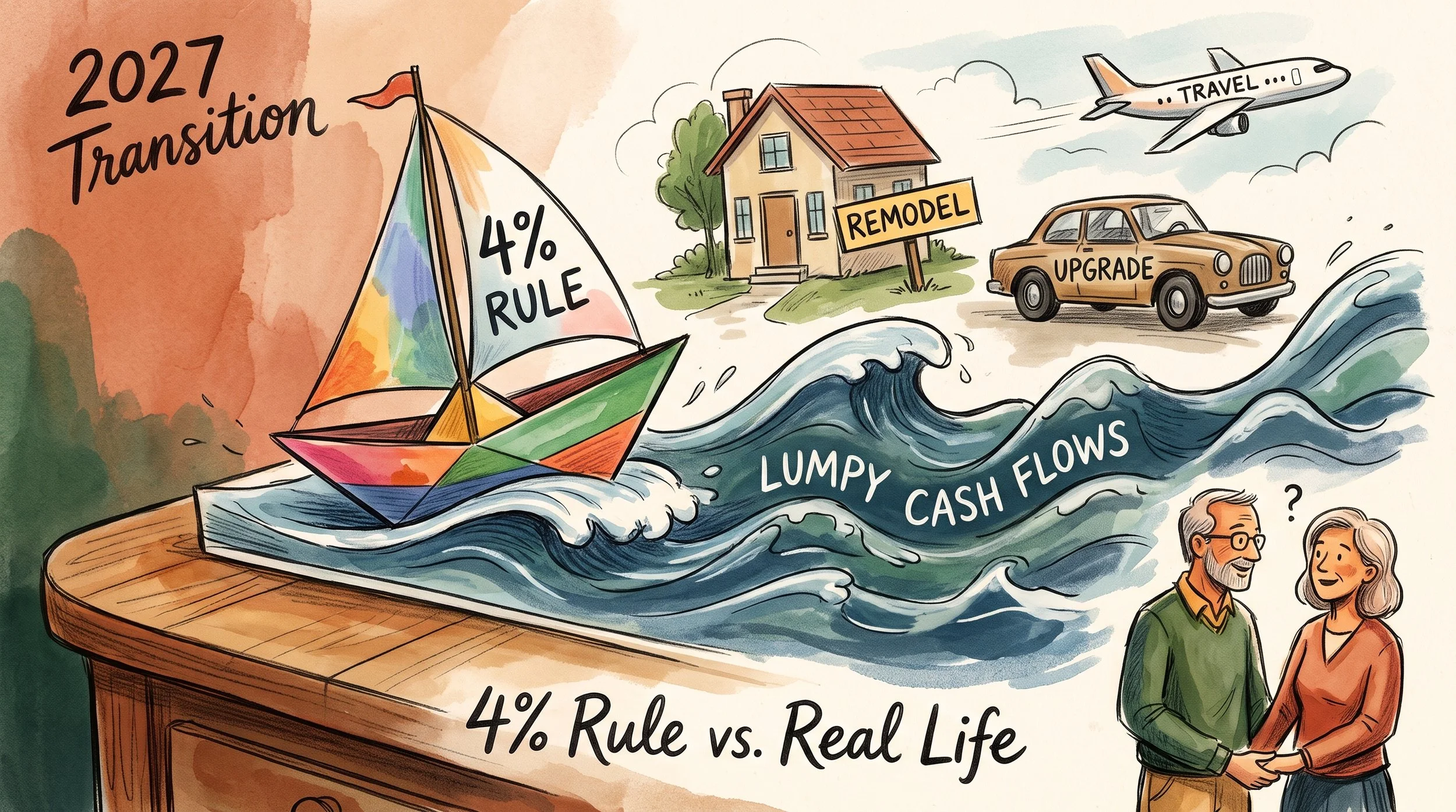
The biggest flaw of the 4% rule is the assumption that your retirement spending will be flat and predictable, adjusting only for inflation. In reality, early retirement is the most irregular, expensive phase of the entire journey.
When you finally have the time and mental bandwidth, you naturally begin addressing major life projects you’ve been putting off for years. Typically, this takes the form of "The Big Three":
House Projects: Remodeling a kitchen, updating a bathroom, or repairing a roof.
Vehicles: Upgrading or replacing a car to ensure reliable transport for the next decade.
Health & Lifestyle: Catching up on medical procedures, traveling while you are still highly active, or taking bucket-list trips.
Because these non-recurring expenses are bunched together early on, your cash flows will be incredibly uneven. To make matters worse, with Full Retirement Age (FRA) for Social Security now set at 67, a 2027 retiree who steps away at 60 or 62 faces a prolonged multi-year gap where their earned income drops to zero while their "go-go" years spending spikes.
While some might suggest using loans to smooth out these temporary expenses, most of my clients are deeply debt-averse. They spent their entire lives trying to get out of debt to reach this point, and going back into debt is a psychological non-starter.
Trying to force a highly "lumpy" early retirement lifestyle into a rigid, flat 4% withdrawal rate simply doesn’t align with how real people spend.
2. 4% Is Either Way Too Much or Way Too Little
For the vast majority of multi-million dollar portfolios, withdrawing a flat 4% rarely fits the actual cash-flow need.
The Low-End Trap: If you retire early in 2027 and try to live on 4% of your assets before Social Security starts, you may find yourself running a stressful annual deficit that you have to try and solve with a temporary, uncomfortable scale-back.
The High-End Abundance: On the other hand, if you have successfully built a $3M to $5M portfolio, spending 4% is often far more than you naturally want or need.
If you are a $4M household, a 4% withdrawal equals $160,000 per year. When you add future Social Security on top of that, your total income might climb past $200,000+ annually.
For the vast majority of DIY retirees I work with, trying to force-spend that much money is actually difficult. Unless you are looking to aggressively inflate your lifestyle—which can feel ridiculous, especially if you have spent decades practicing sensible, low-consumption habits—you would end up buying things you don't care about or simply giving it away.
Your retirement portfolio should fund your lifestyle, not the other way around.
3. The "Account Spaghetti" Nightmare
The 4% rule assumes you can draw 4% across one unified "portfolio." But in real life, a $3M portfolio is almost never sitting in a single account.
Most pre-retirees walk into my office with a messy collection of accounts scattered across multiple financial institutions:
Traditional 401(k)s and IRAs
Roth 401(k)s and Roth IRAs
Joint or individual taxable brokerage accounts
Health Savings Accounts (HSAs) and high-yield savings accounts
For a typical household with 10 to 20 different accounts across three to five financial institutions, executing a highly specific, inflation-adjusted annual withdrawal is a logistical headache.
Tracking, rebalancing, and aggregating that data annually is incredibly labor-intensive. While my engineer and tech-sector clients might occasionally enjoy building custom spreadsheets to track this, most people want to spend their retirement living, not managing complex accounting tasks.
The Path Forward: Designing a Dynamic Spending Plan
Instead of forcing your life to fit a thirty-year-old academic formula, your 2027 retirement plan should be built around dynamic spending.
This means:
Identifying your baseline expenses versus your flexible, discretionary spending.
Sizing a dedicated "safe runway" (usually 2 to 4 years of cash and short-term reserves) to fund your uneven early expenses and shield you from bear markets.
Building a tax-efficient withdrawal strategy that takes your natural "tax valley" years into account, rather than pulling blindly from every account.
The 4% rule is a helpful starting benchmark, but your actual life will have twists, turns, and lumpiness that require a far more personalized, flexible strategy.
Get a Blueprint Tailored to Your 2027 Transition
Planning to make 2027 your final year in the workforce? You don't need a decades-old thumb-rule—you need a customized cash-flow and tax strategy that matches how you actually live.
At Barrett FP LLC, we offer hourly, advice-only financial planning. We don't manage your assets or take commissions—we just provide the objective, fiduciary analysis you need to verify your numbers and transition with confidence.